|
|
 |
Medicine and Society
........................................................
Clinical
Research and Methods
........................................................
|
Chief
Editor -
Abdulrazak
Abyad
MD, MPH, MBA, AGSF, AFCHSE
.........................................................
Editorial
Office -
Abyad Medical Center & Middle East Longevity
Institute
Azmi Street, Abdo Center,
PO BOX 618
Tripoli, Lebanon
Phone: (961) 6-443684
Fax: (961) 6-443685
Email:
aabyad@cyberia.net.lb
.........................................................
Publisher
-
Lesley
Pocock
medi+WORLD International
11 Colston Avenue,
Sherbrooke 3789
AUSTRALIA
Phone: +61 (3) 9005 9847
Fax: +61 (3) 9012 5857
Email:
lesleypocock@mediworld.com.au
.........................................................
Editorial
Enquiries -
abyad@cyberia.net.lb
.........................................................
Advertising
Enquiries -
lesleypocock@mediworld.com.au
.........................................................
While all
efforts have been made to ensure the accuracy
of the information in this journal, opinions
expressed are those of the authors and do not
necessarily reflect the views of The Publishers,
Editor or the Editorial Board. The publishers,
Editor and Editorial Board cannot be held responsible
for errors or any consequences arising from
the use of information contained in this journal;
or the views and opinions expressed. Publication
of any advertisements does not constitute any
endorsement by the Publishers and Editors of
the product advertised.
The contents
of this journal are copyright. Apart from any
fair dealing for purposes of private study,
research, criticism or review, as permitted
under the Australian Copyright Act, no part
of this program may be reproduced without the
permission of the publisher.
|
|
|
| March 2015 - Volume
13 Issue 2 |
|
Satisfaction
with nursing care from the inpatients` perspective
in Prince Salman Armed Forced Hospital Tabuk,
Saudi Arabia
Majed
Al Qahtani
Salem Khalil Al Dahi
Prince Salman Armed Forces Hospital
Tabuk, Saudi Arabia
Correspondence:
Majed
Al Qahtani
Prince
Salman Armed Forced Hospital
Tabuk, Saudi Arabia
Email:
librarynwafh@hotmail.com
|
Abstract
Background: Patient satisfaction
with nursing care is important for any
health care agency because nurses comprise
the majority of health care providers
and they provide care for patients 24
hours a day.
Objectives: To assess nursing care
from patients` perspective as well as
to study the difference in the level of
patients` satisfaction and their perspectives
in relation to demographic background
of patients and hospital characteristics.
Subjects and Methods: This cross-sectional
study included a representative sample
of inpatients in Prince Salman Armed Forces
hospital, Tabuk, KSA from all main departments
(medical, surgical, nephrology, orthopedic
and obstetrics & gynecology departments).
Arabic version of Newcastle Satisfaction
with Nursing scale (NSNS) was used for
data collection.
Results: Out of 420 patients invited to
participate in the study, 414 filled in
the questionnaires giving a response rate
of 98.6%. The study included 414 admitted
patients. Their age ranged between 18
and 74 with a mean of 38.5 (SD=14.2) years.
Males represent 59.4% of them. 44.9% of
patients reported below good, while 55.1%
of them reported good experience of nursing
care score. None of the participants reported
above good (>80%) experience of nursing
care score. The participants were mostly
experienced with team work between Doctors
and nurses and collaboration between nurses
of different shifts. 73.9% of patients
reported low (<60%) while 26.1% reported
moderate satisfaction with nursing care
score. None of the participants reported
high (>80%) satisfaction with nursing
care score. Male, higher educated patients,
those admitted to obstetrics and gynecology
and stayed for 2-3 weeks in hospitals
were more likely to express higher experience
of nursing care and satisfaction with
nursing care scores.
Conclusions: Patient satisfaction
with nursing care is generally low in
the recent study. The findings provide
nurses with information about aspects
that enhance or hinder patient satisfaction.
Key words: Patient
Satisfaction, Nursing Care, Quality of
Health Care, Questionnaires,
Saudi Arabia
|
Patient satisfaction is the patient's perception
of care received compared with the care expected.(1)
During hospitalization, patient satisfaction
represents a balance between the patient's perception
and expectation of their nursing care. (2)
Quality of care is a system approach to health
services, which emphasizes both technical competence
as well as interpersonal dimension of "health
care giving process". Client's/patient's
satisfaction is one of the two main components
of quality of care which includes respect for
the client/patient and understanding the needs
of the client and providing services accordingly.(3)
Patient satisfaction has been used as an indicator
of quality of services provided by health care
personnel. The most important predictor of patient`
overall satisfaction with hospital care is particularly
related to their satisfaction with nursing care.(4-5)
It is becoming increasingly recognized that
patient's views should be taken into account
as a part of comprehensive assessment of quality
of care.(6) Patients` experiences in hospitals
offer insights into areas that need improvement,
and high nurse-staffing levels may be associated
with better experiences for patients.(7)
Data about patient satisfaction equips nurses
with useful information about the structure,
process and outcome of nursing care such as
adequacy of staffing, therapeutic needs and
patient behaviors.(8-9) The number of patient
satisfaction questionnaires has proliferated
over the last decades as tools to measure health
care from the patients` perspective.(10-12)
One common target group has been patients admitted
to a hospital, because admission can be a stressful
and dissatisfying experience for many people
and because of the high health care costs, than
an admission to a health care system entails.(13)
Patient satisfaction with nursing care is important
for any health care agency because nurses comprise
the majority of health care providers and they
provide care for patients 24 hours a day.(14-15)
A cross-sectional study
was conducted at Prince
Salman Armed Forces hospital
in Tabuk, KSA. The bed
capacity in Prince Salman
armed forced hospital
is 402 beds providing
primary, secondary and
tertiary care. All inpatients
in Prince Salman Armed
Forces hospital, Tabuk,
KSA were in all main departments
(medical, surgical, nephrology,
orthopedic and obstetrics
& gynecology departments).
Sample size and sampling
technique
Approximately 25,000 patients
were admitted to the studied
hospital per year. Assuming
that the patient dissatisfaction
represents 20% and by
accepting an error of
4% the calculated sample
size at 95% level of confidence
was 377 using Epi info
software. In order to
compensate for drop out
(non-respondent ), a total
of 420 patients was sufficient
for the study by recruiting
of all patients admitted
at Tabuk armed force hospital
during the period of 25
th August till 25 th September,
2013, provided that they
are fulfilling the criteria
of inclusion in the study,
the required sample was
achieved.
Study tool and procedure:
The Arabic version of
Newcastle Satisfaction
with Nursing scale (NSNS)(14)
was used for data collection.
The NSNS was selected
for data collection for
the current study because
(i) it was found to be
valid and reliable in
previous studies conducted
in both Western(13) and
Arabic countries (Jordan)
(15), (ii) it can detect
differences in the level
of satisfaction between
wards in the same hospital
and different hospitals,(16)
and it addresses nursing
care rather than other
dimensions of the hospital
experience. (17)
The questionnaire consists
of three components:
1- Experience
of nursing care: Patient`s
experience of nursing
care is defined as the
cognitive judgment of
several aspects of nursing.
(18) Respondents rated
their experience of nursing
care on 26 items, using
a five-point Likert scale
(1=strongly disagree,
5= strongly agree).
2- Opinions of nursing
care (satisfaction with
nursing care): Patient
satisfaction with nursing
care is defined as the
emotional reaction of
the patient to several
aspects of nursing care.
(18) Respondents rated
their satisfaction with
various aspects of nursing
care, using a five-point
Likert scale (1= not at
all satisfied, 5= completely
satisfied). This section
consisted of 19 items.
The maximum scores for
patients` experiences
and satisfaction were
calculated out of 100.
The scores were categorized
into three levels: (i)
a score less than 60%
indicated "below
good" level of experience
or "low" level
of satisfaction with nursing
care; (ii) a score between
60-80% indicated "good"
level of experience or
"moderate" level
of satisfaction with nursing
care; and (iii) a score
of more than 80% indicated
an "above good"
level of experience or
"high" level
of satisfaction with nursing
care.(15)
3- Demographic information:
This section includes
gender, age, marital status,
level of education, ward
and length of stay in
the hospital.
Out of 420 patients
invited to participate
in the study, 414 filled
in the questionnaires
giving a response rate
of 98.6%. The study
included 414 admitted
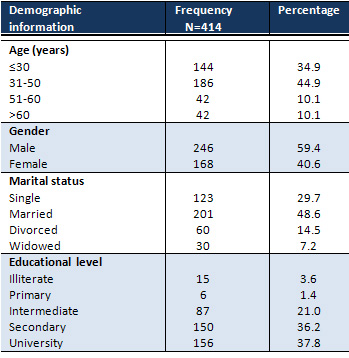
patients. Table 1 presents
their demographic information.
Their age ranged between
18 and 74 with a mean
of 38.5 (SD=14.2) years.
Most of them (79.8%)
were aged 50 years or
less. Males represent
59.4% of them. Almost
half of them (48.6%)
were married. More than
a third of them (37.8%)
were university graduated.
Table 1: Demographic
information of admitted
patients, Prince Salman
Armed Forces hospital,
Tabuk, KSA.
Insight
into
patients
'
perceptions
of
nursing
care
will
help
nurses
to
understand
better
how
to
address
these
patients'
needs
and
expectations
more
appropriately.
The
study
included
414
students
with
a
response
rate
of
98.%.
According
to
Rosnow
and
Rosenthal
(1999).(19)
these
techniques
(e.g.
personal
contact,
using
reminders
and
explaining
the
scientific
importance
and
value
of
the
study,
ensuring
the
participants
confidentiality)
are
linked
to
increased
participation
in
surveys.
Patients`
experiences
of
nursing
care
in
the
current
study
were
generally
good
particularly
in
regards
to
aspects
of
continuity
of
nursing
care.
These
findings
are
consistent
with
the
findings
of
Ahman
and
Alasad
(2004)(7)
and
McColl
et
al
(1996).(5)
Such
results
indicate
the
importance
of
collaboration
and
continuity
of
nursing
care.
Participants
of
the
present
study
had
below
good
experiences
with
aspects
of
no
time
for
nurses
to
sit
and
talk
to
them
and
nurses
completely
relying
on
doctors.
Such
finding
are
also
consistent
with
the
findings
of
Ahmas
and
Alasad
(2004)(7),
McColl
et
al
(1996)(5)
and
Walsh
and
Walsh
(1999).
(20)
On
the
other
hand,
participants`
satisfaction
with
nursing
care
was
generally
low.
The
participants
were
mostly
satisfied
with
aspects
of
nurses`
capability
of
their
jobs,
nurses`
helpfulness,
nurses'
manner
in
going
about
their
work
and
the
amount
nurses
knew
about
patient
care.
These
factors
reflect
the
nurses`
competencies
and
skills,
which
mean
that
satisfaction
of
participants
is
mostly
affected
by
the
skills
and
competencies
of
nurses
in
performing
their
work.
Such
results
are
congruent
with
the
findings
of
Alasad
and
Ahmad
(2003).
(21)
The
participants
were
also
least
satisfied
with
items
such
as
"how
nurses
listened
to
patients`
worries
and
concerns"
and
"the
amount
of
time
nurses
spent
with
patients".
These
aspects
indicate
that
the
time
that
nurses
spend
with
patients
was
not
adequate,
which
might
be
attributed
to
heavy
workload,
inadequate
staffing,
performing
non-nursing
activities
and
the
most
important
aspects
are
nursing
shortage
and
language
barriers.
Such
results
inform
nurses,
nurse
administrators
and
managers
that
despite
cultural
differences,
the
issue
of
spending
inadequate
time
with
patients
and
poor
nursing
autonomy
seem
to
be
common
dissatisfactions
among
patients
with
different
cultures.
These
finding
are
consistent
with
what
has
been
reported
in
a
Jordanian
study
conducted
in
2009.
(15)
Male
patients
were
more
satisfied
and
had
better
experience
of
nursing
care
than
female
patients.
Such
a
result
is
consistent
with
the
findings
of
Ahmad
and
Alasad
(2004).(7)
On
the
other
hand,
such
a
result
is
inconsistent
with
the
findings
of
Alasad
and
Ahmad
(2003)(25),
Easter
et
al
(2003)(22),
Alhusban
and
Abualrub
(2009)(15)
and
Venn
and
Fone
(2005).(23)
The
findings
of
the
current
study
also
indicated
that
patients
with
lower
levels
of
education
had
lower
levels
of
satisfaction
and
experience
of
nursing
care.
Such
findings
were
inconsistent
with
findings
of
Alasad
and
Ahmad
(2003)(20),
Barbara
et
al
(1999)(24)
and
Bodil
(1999).(25)
These
studies
found
that
patients
with
higher
levels
of
education
had
lower
levels
of
satisfaction
with
nursing
care.
This
could
be
attributed
to
language
barriers
that
our
patients
are
facing
as
the
majority
of
nurses
were
Filipinos
and
illiterate
patients
are
not
able
to
contact
with
them
properly.
Other
researchers
indicated
that
patients`
educational
level
had
no
effect
on
their
experience
or
satisfaction
with
nursing
care.
(15,
26-27)
The
findings
of
this
study
revealed
no
significant
influence
of
the
variables
of
age,
marital
status,
and
length
of
stay
on
patient
experience
and
satisfaction
with
nursing
care,
which
is
inconsistent
with
the
findings
of
others.
(25,
28,
29)
On
the
other
hand,
it
was
consistent
with
findings
of
other
researchers
in
Saudi
Arabia
(30)
and
Jordan.(15)
Such
inconsistent
results
in
regard
to
the
association
between
demographic
variables
of
patients
and
the
level
of
satisfaction
call
for
further
research
that
controls
for
other
variables
such
as
the
demographic
variables
of
nurses
who
provide
care
for
those
patients
and
other
organizational
variables
such
as
nurses`
satisfaction.
When
comparing
departments
of
admission,
the
results
showed
that
participants
in
obstetrics
and
gynecological
department
had
higher
level
of
experience
and
satisfaction
with
nursing
care
than
participants
in
surgical
department;
such
a
result
is
consistent
with
the
findings
of
many
researchers.
(20,
26,
30,
31)
A
possible
explanation
for
this
result
might
be
because
of
the
fact
that
the
health
status
of
gynecological
patients
is
better
than
those
in
surgical
departments.
Usually,
patients
who
are
admitted
to
surgical
departments
are
more
sensitive
to
the
quality
of
care
they
receive
because
of
their
reduced
health
status.
In
the
present
study,
experience
of
nursing
care
and
satisfaction
with
nursing
care
were
significantly
associated
despite
them
having
different
operational
definition.
Experience
of
nursing
care
was
measured
by
26
items
(cognitive
judgment);
whereas,
satisfaction
with
nursing
care
was
measured
by
19
different
items
(emotional
judgment).
A
limitation
of
the
research
is
the
sampling
of
this
study
as
it
included
patients
from
one
hospital
that
affects
the
ability
to
generalize
the
findings.
In
addition,
the
cross-sectional
design
of
the
survey
makes
it
difficult
to
sort
out
the
causal
relationships
among
variables
studied.
.Identifying
the
level
of
patients`
satisfaction
with
nursing
care
is
a
good
indicator
for
the
quality
of
nursing
care
services.
The
findings
of
the
present
study
provide
nurses
with
information
about
aspects
that
enhance
or
hinder
patient
satisfaction.
Patient
satisfaction
with
nursing
care
is
generally
low.
Female,
lower
educated
and
those
admitted
to
the
surgical
department
experienced
lower
level
of
satisfaction
with
nursing
care.
The
findings
of
this
study
provide
a
framework
for
both
nurse
managers
and
unit
nurse
managers
to
seriously
think
when
planning
for
steps
to
take
towards
implementing
patient
centered
health
care.
1.
Aiello
A,
Garman
A,
Morris
BS.
Patient
satisfaction
with
nursing
care:
A
multilevel
analysis.
Journal
of
Quality
Management
in
Health
Care
2003;
12
(3):
187-191.
2.
Han
CH.
Measuring
patient
satisfaction
as
an
outcome
of
nursing
care
at
a
teaching
hospital
of
Southern
Taiwan.
Nursing
Care
Quality
Journal
2003;
18
(2):
143
-150.
3.
Staniszewska
S,
Ahmed
L.
Patient
expectation
and
satisfaction
with
health
care.
Nursing
Standard1998;
12:34-38
4.
O'Connell
B,
Young
J,
Twigg
D.
Patient
satisfaction
with
nursing
care:
a
measurement
conundrum.
Int
J
Nurs
Pract1999;
5:727
5.
McColl
E,
Thomas
L,
Bond
S.
A
study
to
determine
patient`s
satisfaction
with
nursing
care.
Nursing
Standard1996;
10:34-38
6.
Phi
I,
Nguyen
T,
Briancon
S,
Empereur
F,
Guillemin
F.
Factors
determining
inpatient
satisfaction
with
care.
Social
Science
&
Medicine
2002;
54:
493-504
7.
Ahmad
M,
Alasad
J.
Predictors
of
patients`
experiences
of
nursing
care
in
medical-surgical
wards.
International
Journal
of
Nursing
Practice
2004;
10:
235-241
8.
Ebright
P,
Patterson
E,
Chalko
B,
Render
ML.
Understanding
the
complexity
of
registered
nurse
work
in
acute
care
settings.
JONA.2003;33(22):630-8.
9.
Bally
JM.
The
role
of
nursing
leadership
in
creating
a
mentoring
culture
in
acute
care
environments.
Nurs
Econ.
2007;
25(3):143-8.
10.
Rubin
HR.
Patient
evaluations
of
hospital
care.
A
review
of
the
literature.
Med
Care.
1990;
28:S3-S9.
11.
van
Campen
C,
Sixma
H,
Friele
RD,
Kerssens
JJ,
Peters
L.
Quality
of
care
and
patient
satisfaction:
a
review
of
measuring
instruments.
Med
Care
Res
Rev.1995;
52:109-133.
12.
Sitzia
J,
Wood
N.
Patient
satisfaction:
a
review
of
issues
and
concepts.
Soc
Sci
Med.1997;
45:1829-1843.
13.
Quintana
JM,
González
N,
Bilbao
A,
Aizpuru
F,
Escobar
A,
Esteban
C,
et
al.
Predictors
of
patient
satisfaction
with
hospital
health
care.
BMC
Health
Serv
Res.
2006;
6:
102.
14.
McDonnel
C,
Nash
J.
Compensation
of
instruments
measuring
patient
satisfaction
with
nursing
care.
Quality
Review
Bulletin
1990;
5:
182-188
15.
Alhusban
MA,
Abualrub
RF.
Patient
satisfaction
with
nursing
care
in
Jordan.
J
Nurs
Manag.
2009
Sep;
17(6):749-58.
16.
Thomas
L,
McColl
E,
Priest
J,
Bond
S,
Boys
R.
Newcastle
satisfaction
with
nursing
scales:
an
instrument
for
quality
assessment
of
nursing
care.
Quality
in
Health
Care
1996;5(2):67-72
17.
Peterson
W,
Charles
C,
DiCenso
A,
Sword
W.
The
Newcastle
Satisfaction
with
Nursing
Scale:
a
valid
measure
of
maternal
satisfaction
with
inpatient
postpartum
nursing
care.
Journal
of
Advanced
Nursing
2005;52(6):672-681.
18.
Pascore
G.
Patient
satisfaction
in
primary
health
care:
a
literature
review
and
analysis.
Evaluation
and
Program
Planning
1983;6:185-210
19.
Rosnow
R,
Rosenthal
R.
Psychology;
Social
sciences;
Research;
Methodology
In:
Beginning
behavioral
research:
A
conceptual
primer.
Published
by:
Prentice
Hall
(Upper
Saddle
River,
NJ),
3rd
edition,
1999;
475-81.
20.
Walsh
M,
Walsh
A.
Measuring
patient
satisfaction
with
nursing
care:
experience
of
using
the
Newcastle
Satisfaction
with
Nursing
Scale.
Journal
of
Advanced
Nursing
1999;29(2):307-315.
21.
Alasad
J,
Ahmad
M.
Patient`s
satisfaction
with
nursing
care
in
Jordan.
International
Journal
of
Health
Care
Quality
Assurance
2003;16(6):279-285
22.
Easter
C,
Karen
H,
Lynn
C.
The
influence
of
demographic
variables
and
ward
type
on
elderly
patient`s
perceptions
of
needs
and
satisfaction
during
acute
hospitalization.
International
Journal
of
Nursing
Practice
2003;9:191-201
23.
Venn
S,
Fone
D.
Assessing
the
influence
of
socio-demographic
factors
and
health
status
on
expression
of
satisfaction
with
GP
services.
Clinical
Governance:
An
International
Journal
2005;10(2):118-125
24.
Barbara
A,
Davis
D,
Elaina
D.
Patient
satisfaction
with
nursing
care
in
a
rural
and
an
urban
emergency
department.
Australian
Journal
of
Rural
Health
1999;7:97-103
25.
Bodil
W.
Patients
views
on
quality
of
care:
age
effects
and
identification
of
patient
profiles.
Journal
of
Clinical
Nursing
1999;8:693-700
26.
Akin
S,
Erdogan
S.
The
Turkish
version
of
the
Newcastle
Satisfaction
with
Nursing
Care
Scale
used
on
medical
and
surgical
patients.
Journal
of
Clinical
Nursing
2007;16:646-653.
27.
Chang
J,
Chau
J.
Patient
satisfaction
with
triage
nursing
in
Hong
Kong.
Journal
of
advanced
Nursing
2005;50(5):498-507
28.
Stephen
A,
Margolis
A,
Al-Marzouqi
S,
Revel
T,
Richard
L.
Patient
satisfaction
with
primary
health
care
services
in
the
United
Arab
Emirates.
International
Journal
for
Quality
in
Health
Care
2003;3:241-249.
29.
Vincent
S,
Burman
M,
Mary
B.
Continuity
of
care
and
other
determinants
of
patient
satisfaction
with
primary
care.
Health
Services
Research
and
Development
Center
of
Excellence
2004;8:226-233
30.
Al
Momani
M,
Al
Korashy.
Patient
experience
of
nursing
quality
in
a
teaching
hospital
in
Saudi
Arabia.
Iranian
J
Public
Health
2012;41(8):42-49
31.
Phi
I,
Nguyen
T,
Briancon
S,
Empereur
F,
Guillemin
F.
Factors
determining
inpatient
satisfaction
with
care.
Social
Science
and
Medicine
2002;54:493-504
|
|
.................................................................................................................

|
| |
|