|
|
 |
Medicine and Society
........................................................
Clinical
Research and Methods
........................................................
|
Chief
Editor -
Abdulrazak
Abyad
MD, MPH, MBA, AGSF, AFCHSE
.........................................................
Editorial
Office -
Abyad Medical Center & Middle East Longevity
Institute
Azmi Street, Abdo Center,
PO BOX 618
Tripoli, Lebanon
Phone: (961) 6-443684
Fax: (961) 6-443685
Email:
aabyad@cyberia.net.lb
.........................................................
Publisher
-
Lesley
Pocock
medi+WORLD International
11 Colston Avenue,
Sherbrooke 3789
AUSTRALIA
Phone: +61 (3) 9005 9847
Fax: +61 (3) 9012 5857
Email:
lesleypocock@mediworld.com.au
.........................................................
Editorial
Enquiries -
abyad@cyberia.net.lb
.........................................................
Advertising
Enquiries -
lesleypocock@mediworld.com.au
.........................................................
While all
efforts have been made to ensure the accuracy
of the information in this journal, opinions
expressed are those of the authors and do not
necessarily reflect the views of The Publishers,
Editor or the Editorial Board. The publishers,
Editor and Editorial Board cannot be held responsible
for errors or any consequences arising from
the use of information contained in this journal;
or the views and opinions expressed. Publication
of any advertisements does not constitute any
endorsement by the Publishers and Editors of
the product advertised.
The contents
of this journal are copyright. Apart from any
fair dealing for purposes of private study,
research, criticism or review, as permitted
under the Australian Copyright Act, no part
of this program may be reproduced without the
permission of the publisher.
|
|
|
| March 2015 - Volume
13 Issue 2 |
|
Knowledge,
Attitude and Practice of Primary Health Care Physicians
in Bahrain towards Complementary and Alternative
Medicine (CAM)
Adel Salman Al Sayyad
(1)
Reem Al Saffar
(2)
Hala Al Jasim
(2)
Fatima AlReqraq
(2)
Bushra S. Ahmed
(2)
(1) Consultant Family Medicine & Epidemiology,
Ministry of Health
(2) Consultant Family Physician, Ministry of
Health
Correspondence:
Adel Salman AlSayyad, MD, ABFM, DLSHTM
Chief of Disease Control Section, PHD, MOH-
Bahrain
P.O. Box 12,
Manama, Kingdom of Bahrain.
Mobile: (+973) 39687214
Office Tel: (+973) 17279234
Email:
Asayyad@health.gov.bh
|
Abstract
Introduction
: The use of CAM has become popular
and widely practiced among the general
population. The integration of CAM into
the ordinary medical system has been encouraged
by World Health Organization (WHO) to
improve the quality of care in the health
for all strategy. This research aims at
studying the knowledge, attitude and practice
of primary health care doctors towards
CAM in Bahrain.
Method:
A cross sectional study of all the
323 primary health care doctors who are
working in the governmental health centers
in Bahrain were the study population.
A self-filled questionnaire was used for
data collection. The Questionnaires were
distributed to all primary health care
doctors by name and collected after one
week through the chief of medical services
of primary health care. Data were entered
and analyzed using SPSS program
version 18.
Results:
Two hundred and twenty two (68.7%) questionnaires
out of 323 questionnaires were completed.
Around half (50.5%) of the respondents
stated that they have a poor level of
knowledge about CAM, while only 6 (2.7%)
of them stated that they have an excellent
level of knowledge. General non-medical
sources were the main source of knowledge
about CAM with general reading ranked
as the main source (48.2%), followed by
general media like TV and radio (34.2%),
and followed by internet (23%).
In general, the attitude of primary care
doctors toward CAM was positive with 72.5%
of them interested in CAM, 81.1% believe
that training in CAM would affect their
practice as doctors, and 73.9% agreed
that CAM is beneficial.
Regarding the practice of PHC doctors
toward CAM, more than half (59.5%) had
used CAM with their patients, while only
23% of them had referred patients to CAM
practitioners. Most of PHC doctors (79.7%)
stated that they asked their patients
about the use of CAM.
Conclusion:
Primary Health Care doctors in Bahrain
have a poor knowledge about CAM and would
like to know more about it. On the other
hand, they have a good attitude towards
using CAM with their patients.
Key words:
Knowledge, Attitude, Practice, Primary
Health Care, Complementary, Alternative,
Bahrain.
|
The National Centre for Complementary and Alternative
Medicine (CAM) define CAM as "a group of
diverse medical and health care systems, practices
and products that are not presently considered
to be part of conventional medicine". [1]
CAM usually refers to a large range of therapies
outside the mainstream of western medicine.
[2] Some of these therapies receive a reasonable
acceptance by the medical Profession whereas
others are viewed with much scepticism, especially
those that have little evidence behind them.
[3]
The use of CAM has become popular and widely
practiced among the general population. [4,5]
Several studies showed that the use of CAM in
different populations, including industrialized
countries, reaches between one third to more
than half of the general population and up to
98% in some other settings.[4,6,7,8,9]
The integration of CAM into the ordinary medical
system has been encouraged by World Health Organization
(WHO) to improve the quality of care in the
health for all strategy.[10]
A study in Saudi Arabia showed that 23.9% of
primary health care patients reported previous
use of traditional remedies. [11]
Because of this wide use of CAM, primary health
care professionals and GPs should be ready to
discuss the indications, contra indications,
and potential side effects of CAM.[12]
Several previous studies examined the knowledge,
attitude and/or practice of GPs toward CAM.
[13,14]
A study in Qatar conducted in 2008, reported
that 39.1% of General Practitioners had poor
knowledge about Complementary and Alternative
Medicine. Self-reported knowledge was highest
for counselling and psychotherapy (69.0%), diet
and supplements (68.1%), acupuncture (45.2%),
herbal medicine (47.3%) and massage (42.5%).
[15] Another study in Kuwait showed that the
majority of the GPs (78.4%) stated that their
knowledge about CAM therapy was poor. Self-reported
knowledge about specific CAM therapies was highest
for herbal and acupuncture (33.0%), and was
the lowest for chiropractic (2.3%).[16]
This research aims at studying the knowledge,
attitude and practice of primary health care
doctors towards CAM in Bahrain.
A cross sectional study
of all the 323 primary
health care doctors who
are working in the governmental
health centers in Bahrain
has been conducted. Those
who were on leave during
the study period or refused
to participate were excluded.
A self-filled questionnaire
was used for data collection.
The items of the questionnaire
were adopted from a previous
studies conducted in Qatar.
[15]
The following items were
included in the questionnaire:
• Demographic (age,
sex, nationality)
• Work factors (qualification,
years of experience, morning
or evening shift)
• Knowledge (definition
of CAM, Types of CAM,
effectiveness of CAM,
health hazards of CAM)
• Attitude (interest
in CAM, legalization of
CAM)
• Practice (prescribing
CAM to patients, referral
to CAM practitioner)
An instruction about filling
the questionnaire was
provided with each questionnaire
and clear instruction
for each question was
included.
The Questionnaires were
distributed to all primary
health care doctors by
name and collected after
one week through the chief
of medical services of
primary health care.
Data were entered and
analyzed using SPSS program
version 18.
Two hundred and twenty
two (68.7%) questionnaires
out of 323 questionnaires
were completed by primary
health care (PHC) doctors
working in the Ministry
of Health.
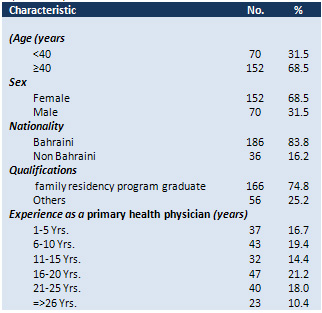
Around two thirds (68.5%)
of the respondents were
above 40 years of age
and the same proportion
(68.5%) were females.
The majority of them
(83.8%) were Bahrainis.
Around three quarters
(74.8%) were a graduate
of Family Residency
program. More than half
(64%) of the respondents
had 10 years or more
of experience as a primary
health care physician.
(Table 1)
Table 1: Demographic
characteristics of the
studied primary health
care doctors in Bahrain
(n = 222)
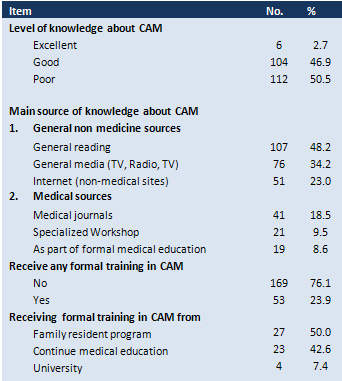
Around half (50.5%)
of the respondents stated
that they have a poor
level of knowledge about
CAM, while only 6 (2.7%)
of them stated that
they have an excellent
level of knowledge.
General non-medical
sources were the main
source of knowledge
about CAM with general
reading ranked as the
main source (48.2%),
followed by general
media like TV and radio
(34.2%), and followed
by internet (23%). On
the other hand, the
medical sources including
medical journals (18.5%),
specialized workshops
(9.5%) and formal medical
education (8.6%) were
minor sources of knowledge
about CAM among the
participants. (Table
2)
Table 2: Self-reported
level of knowledge of
primary health care
doctors in Bahrain about
complementary and alternative
medicine (CAM) (n =
222)
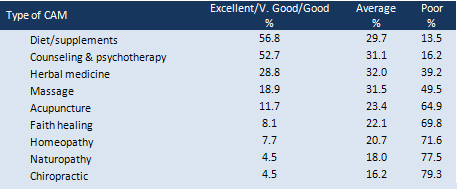
When the participants
were asked regarding
their level of knowledge
about the different
types of CAM therapies,
those who ranked their
knowledge as excellent,
very good or good about
diet and supplement
were 56.8%, about counseling
and psychotherapy were
52.7%, and about herbal
medicine were 28.8%.
On the other hand, they
ranked their level of
knowledge as poor regarding
acupuncture (64.9%),
faith healing (69.8%),
homeopathy (71.6%),
naturopathy (77.5%),
and Chiropractic (79.3%).
(Table 3)
Table 3: Self-reported
level of knowledge of
primary health care
doctors in Bahrain about
different complementary
and alternative medicine
(CAM) therapies (n =
222)
In general, the attitude
of primary care doctors
toward CAM was positive
with 72.5% of them interested
in CAM, 81.1% believe
that training in CAM
would affect their practice
as a doctors, and 73.9%
agreed that CAM is beneficial.
(Table 4)
Table 4: Attitudes of
primary health care
doctors in Bahrain towards
complementary and alternative
medicine (CAM) (n =
222)
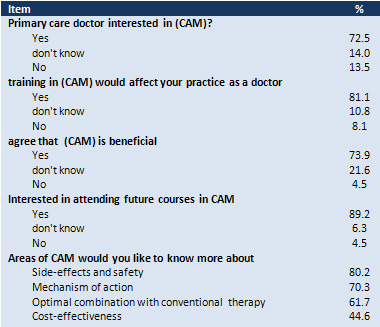
The majority of them
(89.2%) were interested
in attending future
courses on CAM. The
main areas of CAM that
they would like to know
more about were side
effects and safety (80.2%),
mechanism of action
(70.3%), and optimal
combination with conventional
therapy (61.7%). (Table
4)
The majority (83.3%)
of PHC doctors agreed
that they should regularly
ask patients if they
are regularly using
CAM. When asked about
regulation of CAM by
law, 81.5% of PHC doctors
agreed about that. Most
of the participants
(69.8%) agreed that
CAM should be included
in undergraduate medical
education; the majority
(74.8) also agreed that
there is a need for
physician supervision
of CAM. (Table 5)
Table 5 Beliefs of
primary health care
doctors in Bahrain about
complementary and alternative
medicine (CAM) therapies
(n = 222)
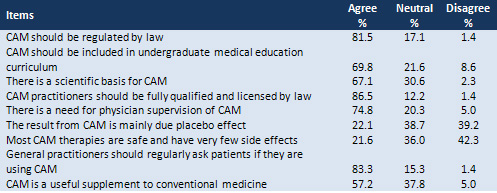
The majority (86.5%)
of PHC doctors agreed
that CAM has a scientific
basis. More than half
of them (57.2%) agreed
that CAM is a useful
supplement to conventional
medicine. On the other
hand only (22.1%) agreed
that the results from
CAM are mainly due to
placebo effect. The
results showed that
the PHC doctors were
not sure about the safety
and the side effects
of CAM therapy, 21.6%
agreed that CAM is safe
while 36% were neutral
and 42.3% disagree that
CAM is safe. (Table
5)
Regarding the practice
of PHC doctors toward
CAM, more than half
(59.5%) had used CAM
with their patients,
while only 23% of them
had referred patients
to a CAM practitioner.
Most PHC doctors (79.7%)
stated that they asked
their patients about
the use of CAM. (Table
6)
Table 6: Practice
of complementary and
alternative medicine
(CAM) by primary health
care doctors in Bahrain
(n = 222)
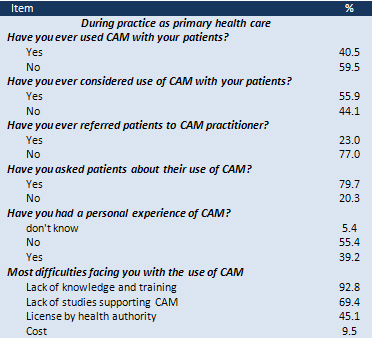
When asked about the
difficulties facing
PHC doctors with the
use of CAM, they stated
that the main reasons
were lack of knowledge
and training (92.8%)
and lack of studies
supporting CAM (69.4%).
(Table 6)
When evaluating practice
areas that are affected
by level of level of
knowledge about CAM
among PHD doctors, we
found that all aspects
of practice were significantly
higher among doctors
with higher level of
knowledge (P <
0.05). (Table 7)
Click here for
Table 7: Association
of level of Knowledge
about complementary
and alternative medicine
(CAM) of primary health
care doctors and their
practices.
CAM
is
considered
one
of
the
important
elements
in
todays
and
future
medical
and
health
practice;
the
research
in
this
field
is
increasing
worldwide.[4,
5,
15,
16]
In
this
study
the
highest
percentage
of
PHC
doctors
evaluated
their
level
of
knowledge
to
be
poor
(50.5%)
which
is
slightly
higher
than
Qatar
(39.1%)
but
better
than
Kuwait
(78.4%).
[15,
16]
This
high
proportion
could
be
related
to
the
fact
that
the
majority
of
the
participants
were
graduated
more
than
10
years
from
the
medical
schools
when
CAM
was
still
not
widely
used.
[6]
Of
the
different
CAM
therapies,
PHC
doctors
reported
more
knowledge
about
diet
and
supplements,
psychotherapy
and
counselling
which
is
similar
to
a
study
conducted
in
Qatar,
[15]
but
different
than
the
studies
conducted
in
UAE
and
Kuwait
which
showed
that
GPs
were
more
aware
about
and
supportive
of
herbal
medicine,
acupuncture
and
homeopathy.
[16,
17]
The
attitude
of
PHC
doctors
in
this
study
was
clearly
positive
toward
CAM
which
is
similar
to
previous
studies
in
the
Gulf
region.
[15,16,17]
The
participants
supported
that
the
practise
of
CAM
in
Bahrain
has
to
be
regulated
by
law
which
matches
the
results
of
the
previous
studies
in
the
Gulf
and
globally.
[15,
16,
3]
Most
PHC
doctors
had
no
previous
training
in
CAM;
however,
89.2%
are
interested
in
attending
future
courses
in
CAM
which
goes
in
parallel
with
the
results
from
UAE,
[15]
while
it
is
different
than
the
Canadian
and
Australian
studies
which
reported
a
higher
level
of
training.
[18,19]
In
this
study
PHC
doctors
had
limited
use
of
CAM
for
their
patients
and
low
referral
rate
to
CAM
practitioners.
These
results
are
similar
to
a
previous
study
conducted
in
Qatar
[15]
but
different
to
the
one
conducted
in
UAE
where
32%
of
GPs
referred
their
patients
to
herbal
medicine
specialties.[17]
On
the
other
hand,
20%
of
GPs
in
Australia,
practised
CAM;
93%
had
referred
their
patients
at
least
once
and
82%
a
few
times
a
year
for
CAM
therapy
[19].
This
limited
use
and
referral
could
be
explained
by
the
lack
of
specialized
and
licenced
CAM
centres
in
Bahrain
and
the
lack
of
knowledge
and
training
of
physicians
in
CAM.
This
study
has
a
lot
of
similarities
with
previous
studies
conducted
in
the
Gulf
region,
but
also
showed
some
variations.
This
indicates
that
despite
the
similar
culture,
beliefs
and
level
of
education,
there
are
still
some
differences
between
the
Gulf
countries
which
indicates
the
need
to
study
this
issue
more
on
a
local
and
regional
level.
The
response
rate
was
lower
than
desired
in
this
study,
but
it
was
similar
to
the
response
seen
in
Qatar
(70%).
[15]
This
is
considered
a
limitation
and
therefore
the
results
should
be
interpreted
with
caution
because
those
with
strong
feelings
towards
CAM
(for
or
against)
may
have
been
more
likely
to
respond
to
the
survey.
Another
limitation
is
the
fact
that
the
study
only
included
primary
care
physicians
working
in
ther
Ministry
of
Health
and
did
not
include
those
working
in
the
private
sector.
Moreover,
it
did
not
include
doctors
from
other
specialities.
Attitudes
and
knowledge
about
CAM
could
be
significantly
different
in
physicians
at
different
levels
and
specialties
of
health
care.
Thus,
it
would
be
interesting
to
compare
attitudes
and
knowledge
across
different
practice
settings.
1-
What
is
complementary
and
alternative
medicine
(CAM)?
Bethesda,
Maryland,
National
Center
for
Complementary
and
Alternative
Medicine,
2005
(Publication
No.
D156)
)
2-
Brian
M.
Berman,
MD,
B.
Krishna
Singh,
PhD,
Lixing
Lao,
PhD,
Betsy
B.
Singh,
PhD,
Kevin
S.
Ferentz,
MD,
and
Susan
M.
Hartnoll.
Physicians'
Attitudes
Toward
Complementary
Or
Alternative
Medicine:
A
Regional
Survey.
3-
Louise
Poynton,
Anthony
Dowell,
Kevin
Dew,
Tony
Egan
(2006).
General
Practitioners'
Attitudes
Toward
(and
Use
of)
Complementary
and
Alternative
Medicine:
A
New
Zealand
Nationwide
Survey.
New
Zealand
Medical
Journal
Vol119
No
1247
ISSN
1175
8716.
4-
Eisenberg
DM
et
al.
Trends
in
alternative
medicine
use
in
the
United
States,
1990-1997.
Results
of
a
follow-up
national
survey.
Journal
of
the
American
Medical
Association,
1998,
280:1569-75.
5-
WHO
traditional
medicine
strategy
2002-2005.
Geneva,
World
Health
Organization,
2002.
6-
Wahner-Roedler
DL
et
al.
Complementary
and
alternative
medicine:
use
by
patients
seen
in
different
specialty
areas
in
a
tertiary-care
centre.
Evidence-based
integrative
medicine,
2004,
1:253-60.
7-
Goldstein
MS
et
al.
The
use
of
complementary
and
alternative
medicine
among
California
adults
with
and
without
cancer.
Evidence-based
complementary
and
alternative
medicine,
2005,
2:557-65.
8-
Ernst
E.
The
role
of
complementary
and
alternative
medicine.
British
medical
journal,
2000,
321:1133-5.
9-
Bodeker
G,
Kronenberg
F.
A
public
health
agenda
for
traditional,
complementary,
and
alternative
medicine.
American
journal
of
public
health,
2002,
92:1582-91.
10-
Lewith
G
et
al.
Developing
CAM
research
capacity
for
complementary
medicine.
Evidence-based
complementary
and
alternative
medicine,
2006,
3:283-9.
11-
Al-Najjar
N,
Taha
AZ,
Alubier
AG.
Prevalence
of
utilizing
native
medicine
among
primary
care
consumers.
Saudi
medical
journal,
1998,
19(5):551-4.
12-
Jonas
WB.
Alternative
medicine
and
the
family
physician.
Journal
of
the
American
Board
of
Family
Practice,
1998,
11:244-6.
13-
Ernst
E,
Resch
KL,
White
AR.
Complementary
medicine.
What
physicians
think
of
it:
a
meta-analysis.
Archives
of
internal
medicine,
1995,
155:2405-8.
14-
Pirotta
M
et
al.
Characteristics
of
Victorian
general
practitioners
who
practice
complementary
therapies.
Australian
family
physician,
2002,
31:1133-8.
15-
Al
Shaar,
M.F.S.
Ismail,
W.A.A.A.
Yousuf
and
R.E.
Salama
.
Knowledge,
attitudes
and
practice
of
general
practitioners
towards
complementary
and
alternative
medicine
in
Doha,
Qatar
.
I.A.M.S..
Eastern
Mediterranean
Health
Journal
EMHJ
o
Vol.
16
No.
5
o
2010
p:
522-527.
16-
Alrashidi,
F.E.,
Sarkhou,
N.N.
and
Alotaibi,
M.S
.
Knowledge
and
Attitudes
of
Complementary
and
Alternative
Medicine
among
General
Practitioners
in
Farwaniya
Health
Region,
Kuwait.
Greener
Journal
of
Medical
Sciences
Vol.
3
(3),
pp.
079-084,
April
2013.
17-
Hassan
MY,
Das
M,
Behjat
S.
Alternative
medicine
and
the
medical
profession:
views
of
medical
students
and
general
practitioners.
Eastern
Mediterranean
health
journal,
2000,
6(1):25-33
(http://www.emro.who.int/publications/emhj/0601/03.htm).
18-
Verhoef
MJ,
Sutherland
LR.
Alternative
medicine
and
general
practitioners:
opinions
and
behavior.
Canadian
family
physician,
1995,
41:1005-11.
19-
Pirotta
MV
et
al.
Complementary
therapy:
have
they
become
accepted
in
general
practice?
Medical
journal
of
Australia,
2000,
172(3):105-9.
|
|
.................................................................................................................

|
| |
|